| Availability: | |
|---|---|
| Quantity: | |
SHUANGTENG
◉ The PE-UHMW inner pipe strictly follows the extrusion type with a viscosity average molecular weight M greater than 3 million
◉ The PE-UHMW base resin is the main component, with various additives not exceeding 5% in the formula and non melting processing technology. The extrusion speed is not greater than 1.1m/h, which maximizes the wear resistance and ensures that the performance of the PE-UHMW inner pipe meets the requirements of QB/T2668.1-2017 "Ultra High Molecular Weight Polyethylene Pipe".
◉ The PE-UHMW inner pipe in contact with the conveying medium gives SRUP excellent performance in terms of wear resistance, corrosion resistance, self-lubricating, non scaling, extremely low friction coefficient, and low conveying energy consumption.
◉ Steel plastic composite, high-strength steel wire bears about 70% of the internal pressure load. SRUP has high pressure bearing capacity, large flow area, extremely low friction coefficient, and excellent hydraulic characteristics, making it energy-saving and environmentally friendly.
◉ Adhesive thermoplastic composite pipe, with peel strength meeting the requirements of CJ/T 189-2007, outer layer made of polyethylene pipe special material, mainly using electric melting connection, convenient, fast, safe and reliable.
| Outer Diameter dₙ / mm | Average Outer Diameter dₑₘ / mm | PE Protective Layer Minimum Wall Thickness eᵧ,ₘᵢₙ / mm | Nominal Pressure PN / MPa | ||||||||||
| dₑₘ,ₘᵢₙ / mm | dₑₘ,ₘₐₓ / mm | 1.0 | 1.6 | 2.0 | 2.5 | 3.5 | |||||||
| Minimum Wall Thickness e Range / mm | |||||||||||||
| ≥ | ≤ | ≥ | ≤ | ≥ | ≤ | ≥ | ≤ | ≥ | ≤ | ||||
| 160 | 160.0 | 162.0 | 2.5 | — | — | — | — | 12.0 | 14.2 | 12.0 | 14.2 | 12.0 | 14.2 |
| 200 | 200.0 | 202.3 | 2.5 | — | — | — | — | 12.0 | 14.2 | 12.5 | 14.7 | 13.0 | 15.2 |
| 225 | 225.0 | 227.5 | 2.5 | — | — | — | — | 12.0 | 14.2 | 12.5 | 14.7 | — | — |
| 250 | 250.0 | 252.5 | 2.5 | — | — | 12.0 | 14.2 | 12.0 | 14.2 | 13.0 | 15.2 | — | — |
| 315 | 315.0 | 317.7 | 3.5 | 13.0 | 15.5 | 13.0 | 15.5 | 13.0 | 15.5 | 14.5 | 17.0 | — | — |
| 355 | 355.0 | 357.8 | 3.5 | 13.0 | 15.5 | 14.0 | 16.5 | — | — | — | — | — | — |
| 400 | 400.0 | 403.0 | 3.5 | 13.0 | 15.5 | 15.0 | 17.8 | — | — | — | — | — | — |
| 431 | 431.0 | 434.0 | 3.5 | 13.5 | 16.0 | 15.5 | 18.3 | — | — | — | — | — | — |
| 450 | 450.0 | 453.2 | 3.5 | 14.0 | 16.5 | 16.0 | 18.8 | — | — | — | — | — | — |
| 483 | 483.0 | 486.2 | 3.5 | 15.0 | 17.5 | 16.5 | 19.3 | — | — | — | — | — | — |
| 500 | 500.0 | 503.2 | 3.5 | 16.0 | 18.8 | 18.0 | 20.8 | — | — | — | — | — | — |
| 560 | 560.0 | 563.2 | 3.5 | 20.0 | 23.0 | 21.0 | 24.0 | — | — | — | — | — | — |
| 630 | 630.0 | 633.2 | 3.5 | 22.0 | 25.0 | 24.0 | 27.0 | — | — | — | — | — | — |
The thinnest wall thickness of the PE-UHMW inner layer shall not be less than 1/3 of the minimum wall thickness e of the pipe.
The thinnest part of the PE-UHMW inner layer has a wall thickness of not less than 6.0mm.
Note 1: Pipes with specifications and/or pressure ratings not specified in the table can be customized.
Note 2: The wall thickness of the pipe and/or the inner wall thickness of PE-UHMW can be customized.
Note 3: When conveying strongly worn media, it is advisable to use end injection molded ultra-high molecular weight polyethylene steel skeleton composite pipes.
1. Hydrostatic strength and burst pressure
| Test Type | Test Temperature / ℃ | Test Pressure / MPa | Test Duration / h | Performance Requirement | Test Method |
| Hydrostatic Strength | 20 | 2PN | 1 | No rupture, no leakage | GB/T 6111 |
| 60 | 1.5×0.7PN | 165 | No rupture, no leakage | GB/T 6111 | |
| Burst Pressure | 20 | Continuous pressure increase until specimen bursts | — | ≥ 3PN | GB/T 15560 |
Note: When the nominal diameter is ≥ 250, the burst pressure test is not mandatory.
2. Physical and mechanical properties
| Serial Number | Item | Requirement | Test Conditions | Test Method |
| 1 | Melt Mass Flow Rate (MFR) | The change of PE MFR before and after processing shall not exceed ±25% | 5kg, 190℃ | GB/T 3682 |
| 2 | Thermal Stability (Oxidation Induction Time) | ≥ 20 min | 210℃ | GB/T 19466.6 |
| 3 | Stress Crack Stability | No cracks, delamination or cracking phenomenon | 100 mm/min | GB/T 32439 |
| 4 | Peel Strength | ≥ 10 N/mm | 100 mm/min | GB/T 2791 |
| 5 | Cut Ring Hydrostatic Strength | No rupture or leakage at the cut annular groove | 20℃, 1.5PN, 165 h | GB/T 32439 |
| 6 | Abrasion Index | ≤ 140 | — | QB/T 2668.1-2017 |
| 7 | Inner Pipe Slurry Abrasion Rate | ≤ 0.30% | — | QB/T 2668-2004 |
3. Pressure derating coefficient for various temperature
| Temperature t / ℃ | t ≤ 20 | 20 < t ≤ 30 | 30 < t ≤ 40 | 40 < t ≤ 50 | 50 < t ≤ 60 |
| Pressure Reduction Coefficient f₁ at Working Temperature | 1.0 | 0.95 | 0.90 | 0.86 | 0.81 |
4. Bending radius
| Nominal Diameter / dₙ | 160 | 200–315 | 355–630 |
| Minimum Allowable Bending Radius | 80d | 100d | 110d |
5. Support spacing
| Nominal Diameter / dₙ | ≤ 200 | > 200 | ||
| Riser | Horizontal Pipe | Riser | Horizontal Pipe | |
| Support Spacing / m | 2.4 | 1.6 | 3.0 | 2.5 |
6. Other engineering design parameters
| Item | Value |
| Medium Temperature | -20 ≤ t ≤ 60℃ |
| Elastic Modulus | 2.8 ~ 3.0 GPa |
| Thermal Conductivity | 0.15 ~ 0.2 W/m·K |
| Wall Roughness | Ra = 0.007 |
| Equivalent Absolute Roughness of Pipe Wall | 0.0015–0.009 mm, unchanged with operating time |
| Hazzen-Williams Coefficient | 155, unchanged with operating time |
| Linear Expansion Coefficient | 12 ~ 15 × 10⁻⁵ m/m·K |
◉《cross helically wound steel wires reinforced ultra-high molecular weight polyethylene composite wear-resistant pipe》Q/STG 07-2022
◉《Technical specification for buried plastic pipeline of water supply engineering》CJJ 101-2016
◉《Code for construction and acceptance of water and sewerage pipeline works》GB/T 50268-2008
◉《Technical specification for stell wire mesh and plastic(PE)composite pipe of water supply pipeline》CECS 181-2005
The friction coefficient of ultra-high molecular weight polyethylene is the smallest, and its wear resistance is superior to that of ultra-high molecular chains, which are particularly long materials such as polytetrafluoroethylene, nylon, and carbon steel contribute to the extremely high wear resistance of SRUP.
1. The influence of molecular weight on wear resistance
The wear values of PE-UHMW pipes measured by Shanghai Chemical Research Institute are listed in the following table:
| Molecular Weight (×10⁶) | 250 | 330 | 500 |
| Wear Loss (g) | 0.0172 | 0.0146 | 0.0139 |
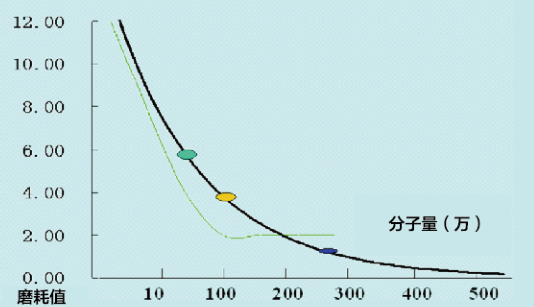
2. Comparison with other materials
The "Research Report on Plastic Pipe Wear Test" by Beijing Nonferrous Metallurgy Design and Research Institute points out that the following four types are not. The results of testing pipelines of the same material under the same diameter, flow rate, test material, and concentration conditions. For: the average annual wear thickness of glass fiber reinforced polypropylene pipes is 11.5424mm/year; Engineering grade polypropylene pipe. (PP) 13.5828mm/year; Ultra high molecular weight polyethylene pipe (UHMW-PE) 5.0104mm/year; steel pipe. (A3) 36.2424mm/year; The experimental results indicate that ultra-high molecular weight polyethylene (UHMW-PE) pipes are wear-resistant. Sex is seven times more than steel pipe (A3).
| Material | UHMW-PE | MC Nylon | Nylon 66 | PTFE | POM | Phenolic Resin | HDPE | PVC | Stainless Steel | Carbon Steel | Brass |
| Wear Rate | 1 | 4 | 5 | 6 | 6 | 16 | 10 | 10 | 7 | 7 | 27 |
3. Comparison with composite pipes made of polyethylene pipes or polyethylene substrates
Appendix A of QBT5101-2017 "Test Method for Wear Resistance of Plastic Pipes" uses dn160 ultra-high molecular weight polyethylene pipes and dn160 polyethylene pipes to conduct wear resistance tests respectively
After 1 million swings, the mass wear of ultra-high molecular weight polyethylene pipes was 39.4 grams and the wall thickness wear was 0.63mm. The mass wear of polyethylene pipes was
79.2 grams, with a wall thickness wear of 1.36mm.
Under the same working conditions, the mass wear and wall thickness wear of ultra-high molecular weight polyethylene pipes are less than 50% of those of polyethylene pipes.
◉ Thermal power generation: transportation of fly ash, return water pipeline.
◉ Oil extraction: long-distance transportation of crude oil.
◉ Coal industry: coal powder transportation, coal water slurry transportation.
◉ Mining industry: transportation of tailings and mud, underground filling of pipelines.
◉ River dredging: transportation of dredged sediment and sand.
◉ Chemical industry: transportation of corrosive media.
◉ Sea and lake salt chemical industry: sea salt transportation, brine transportation.
No. 256 Jinggang Road, Zhangjiagang Free Trade Zone, Jiangsu, China
+86-13372133995
+86-512-58328610